Originally published by super-achiever.com · retrieved 2026-10-30T17:33:51+00:00. Republished here with permission.
The scores, test results, and opinions below are the original source's own and are not independent lab testing or ratings performed by NutritionByMias.
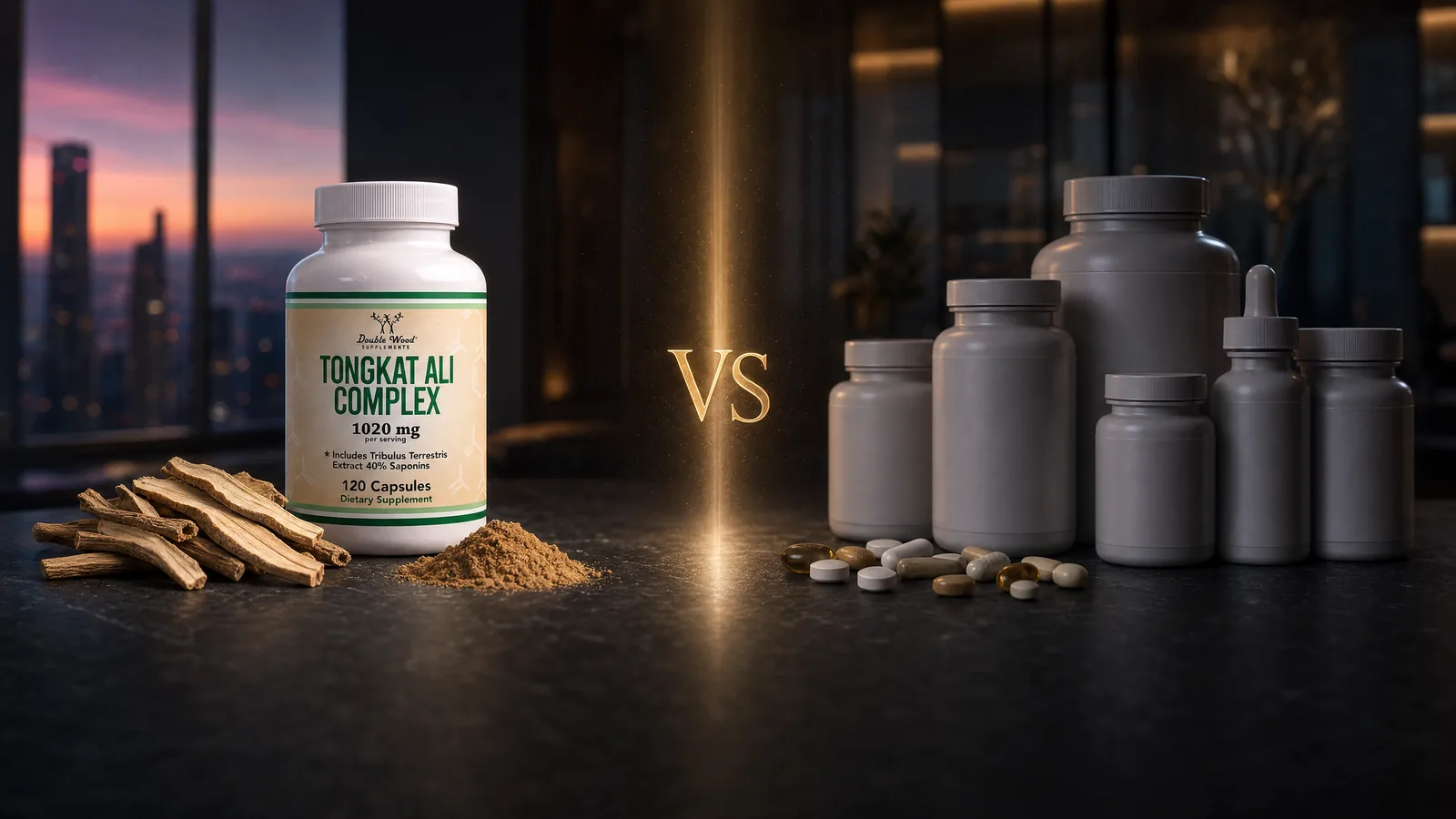
Tongkat Ali vs Common Testosterone Boosters
Walk into any supplement store and you’ll find an entire shelf labeled ‘Testosterone Support’ — Tribulus, D-Aspartic Acid, Fenugreek, ZMA, Horny Goat Weed, and a dozen ‘Test Boost’ multi-ingredient blends. One herb in that category has 10+ placebo-controlled RCTs and a real meta-analysis behind it. The rest of the shelf is mostly marketing.
This is the honest read: Tongkat Ali wins at the category level by a wide margin. But the boosters have a few narrow places where they’re defensible — Fenugreek for libido specifically, Zinc for correcting deficiency. Six rounds below, scored on the evidence, with the narrow exceptions called out where they exist.
Common Testosterone Boosters
The entire ‘everything-else’ T-booster shelf. Mostly weak-to-zero evidence, with a few narrow wins (Fenugreek libido, Zinc deficiency correction).
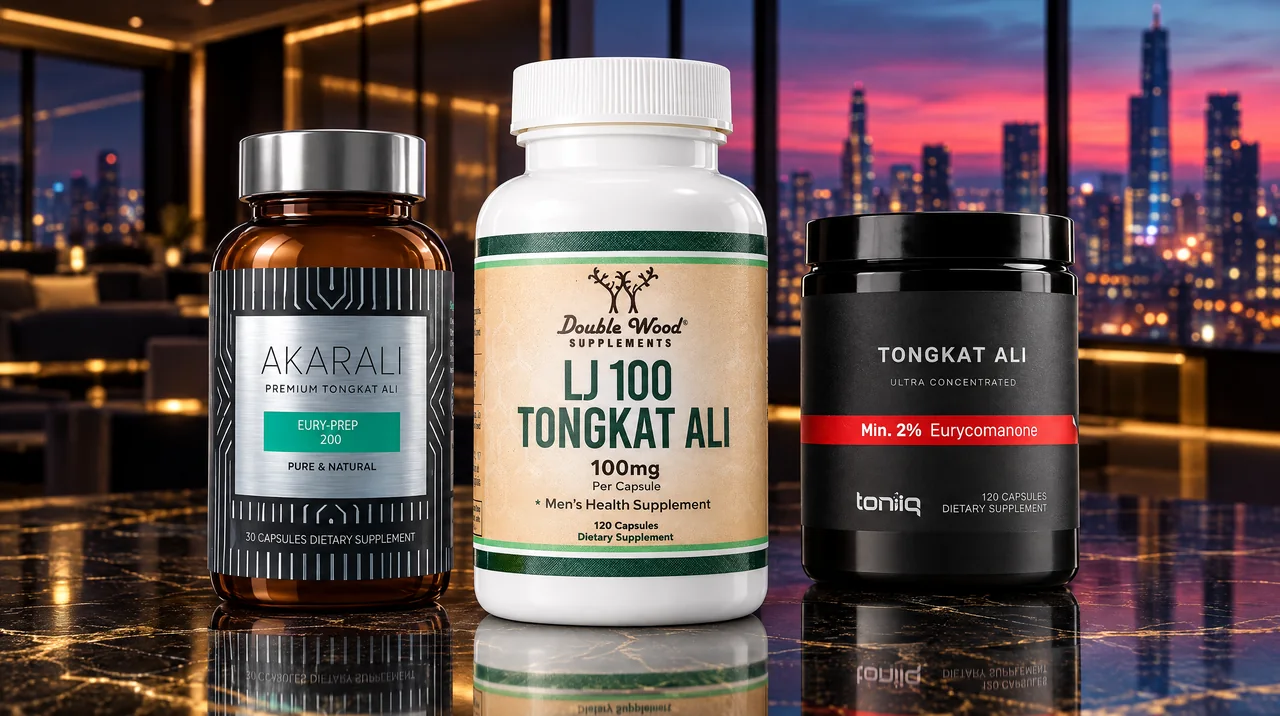
Tongkat Ali (Physta / LJ100)
The only herb in the category with consistent multi-RCT evidence, a validated mechanism, and a real meta-analysis behind the T uplift.
How we scored each round
Five criteria that decide a real-world supplement category-level call. Each round, both sides get a 0-10 score based on the published trials, the mechanism evidence, and the practical cost + safety profile. Weights below sum to 100% — strength-of-evidence and effect-size dominate because at category level, what the trials show matters more than what the marketing says.
-
RCT evidence quality30%
Number of placebo-controlled trials, replication, sample size, meta-analyses. The single biggest factor in a category-level decision.
-
Effect-size magnitude25%
How big is the T uplift vs placebo when the trials are positive? Larger, more consistent shifts score higher.
-
Mechanism specificity20%
Is the pathway validated in human biochemistry, or is it speculative? Specific > generic > unknown.
-
Cost per active mg15%
Monthly cost adjusted for what’s actually evidence-backed — not what’s on the bottle.
-
Safety + drug-test compatibility10%
Adverse event profile and banned-substance flags (Tribulus protodioscin matters here).
6 rounds — head-to-head on the criteria that matter
-
Round 1
Round 1 · Evidence quality
RCT count, replication, meta-analysesCommon Testosterone Boosters4.0 Across the common boosters: Tribulus has 30+ years of mostly null trials, Pokrywka 2014 systematic review confirmed no T effect. D-Aspartic Acid has 1 positive trial (Topo 2009) and a failed replication in trained men (Willoughby 2013). Fenugreek has 3-4 positive libido trials but weak direct-T data. Generic ‘Test Boost’ blends have zero placebo-controlled trials on the combined formula. The category-wide evidence base is thin and inconsistent.
Tongkat Ali (Physta / LJ100)9.5 10+ placebo-controlled RCTs on standardised Tongkat extracts (Physta and LJ100). Tambi & Imran 2022 meta-analysis pooled 5 RCTs with SMD 1.35 (a ‘large’ effect by Cohen’s convention). Talbott 2013 is the cornerstone (+37% T at 200 mg/4 wk). Mechanism replicated across multiple research groups. No category-wide replication problem.
-
Round 2
Round 2 · Tribulus head-to-head
The category’s bestselling herb vs TongkatCommon Testosterone Boosters2.0 Tribulus terrestris has been sold as a T booster since the 1980s based on a Bulgarian study that didn’t replicate. Neychev 2005 (PMID 15994038) tested it in healthy young men 20-36 at 10 mg/kg/day for 4 weeks and found ZERO testosterone change vs placebo. Pokrywka 2014 systematic review confirmed null across human trials. Drug-tested athletes have an additional reason to skip it — protodioscin can trigger nandrolone false-positives on competition panels.
Tongkat Ali (Physta / LJ100)9.5 Tongkat at the same human-trial dose range delivers +37% T uplift (Talbott 2013) and SMD 1.35 across the 5-RCT meta-analysis. The mechanism (SHBG displacement) is validated; Tribulus’s proposed mechanism (LH stimulation via protodioscin) doesn’t replicate in humans.
-
Round 3
Round 3 · D-Aspartic Acid
DAA’s positive trial vs Tongkat’s consistencyCommon Testosterone Boosters5.0 D-Aspartic Acid has Topo 2009 (PMID 19860889) — 3.12 g/day for 12 days, +42% T in untrained men with low-normal baseline. That trial is real and is the basis for DAA’s reputation. But Willoughby & Leutholtz 2013 (PMID 24074738) replicated the protocol in resistance-trained men with normal baseline T and found NO testosterone effect. DAA may work briefly in untrained, low-T men. It doesn’t work in the population that buys it (lifters with normal T).
Tongkat Ali (Physta / LJ100)9.0 Tongkat works across BOTH populations — Talbott 2013 tested moderately stressed adults (not low-T-specific) and got +37%. Tambi 2012 tested ADAM-population men (low-T-specific) and restored T to eugonadal range in 90%. No replication failure problem.
-
Round 4
Round 4 · Fenugreek
The most-defensible common booster vs TongkatCommon Testosterone Boosters7.0 Fenugreek (Testofen 600 mg/day) has real libido + sexual-function data in multiple RCTs. Grip-strength signal in trained populations. Plus a soluble-fiber bonus that helps lipid panels. The T uplift is modest — typically single-digit percentage shifts — but the libido and sexual-function endpoints are consistent. The most honest of the common boosters.
Tongkat Ali (Physta / LJ100)8.5 Tongkat covers libido AND total T uplift. The 5-RCT meta-analysis SMD 1.35 includes libido endpoints alongside T. Outperforms Fenugreek on the T uplift magnitude (37% vs ~5-10%), comparable or stronger on libido. Mechanism (SHBG displacement) is more specific than Fenugreek’s androgen-receptor sensitivity story.
-
Round 5
Round 5 · Generic ‘Test Boost’ blends
Multi-ingredient kitchen-sink formulas vs pure TongkatCommon Testosterone Boosters3.0 Generic ‘Test Boost’ blends combine 8-15 ingredients (Tribulus, DAA, fenugreek, ZMA, horny goat weed, longjack, ashwagandha) at sub-clinical doses. The math doesn’t work — to fit 12 ingredients in 2-3 capsules, every component is dosed 1/10 to 1/5 of its trial threshold. Zero placebo-controlled trials on the combined formula. The marketing leans on listing big ingredient names; the trial dose for any single one isn’t there.
Tongkat Ali (Physta / LJ100)9.5 Standardised single-ingredient Tongkat at 200 mg matches the trial dose exactly. No dilution, no kitchen-sink dose-splitting, no marketing-by-ingredient-list. You’re paying for the dose that produced the +37% T uplift in Talbott 2013 — not a fractional amount of 12 unproven ingredients.
-
Round 6
Round 6 · Cost + safety + drug-test
Monthly cost at evidence-backed dose, banned-substance riskCommon Testosterone Boosters5.0 Common boosters cost $25-60/month, often more for premium-branded ‘Test Boost’ formulas. Once you adjust for what’s actually evidence-backed (mostly nothing), the cost-per-active-mg is unfavourable. Safety profile varies — Tribulus has protodioscin/nandrolone false-positive risk for drug-tested athletes; high-dose DAA has mild GI side effects; generic blends carry unverified-ingredient risk.
Tongkat Ali (Physta / LJ100)8.5 Tongkat at the trial dose (Physta or LJ100 200 mg) runs $15-45/month — comparable to or cheaper than most blend bottles. Six-month Physta safety data is clean. No banned-substance flags. The only meaningful caution is sleep disruption if dosed after 2 p.m. (and not stacking with TRT).
After 6 rounds
Category-level call: Tongkat. Narrow exceptions, called out honestly.

Six rounds, Tongkat wins five and ties one. That’s the right answer at category level — the evidence isn’t even close. Tongkat Ali has 10x the RCT count of any other herb in the ‘common booster’ category, a positive meta-analysis (Tambi & Imran 2022, SMD 1.35), a validated mechanism (SHBG displacement), and a clean drug-test profile. The rest of the shelf is mostly marketing-driven with a handful of narrow wins.
The narrow exceptions are real and worth naming. If your single priority is libido + sexual function and Tongkat is unavailable, Fenugreek (Testofen 600 mg) is the legitimate alternative — that’s why Round 4 ties. If your serum zinc came back low on labs, fixing the deficiency with bisglycinate zinc beats every herb until you’ve corrected it. These are specific, narrow defensible cases — not the broad ‘all the common boosters work’ framing the supplement-aisle marketing wants you to believe.
The practical path: pull a baseline panel (total T, free T, SHBG, zinc, vitamin D). If zinc or D is low, correct it first. Then start Tongkat — Physta or LJ100, 200 mg AM, 8-12 weeks. Re-test. By cycle two you’ll know whether you need to add a second lever (Ashwagandha for cortisol-mediated cases, Fenugreek for libido-specific cases — never Tribulus, never DAA in trained men, never generic ‘Test Boost’ blends). Don’t gamble on the everything-else shelf. The evidence picked a winner a decade ago.
Every claim above traces back to one of these
-
[1]Talbott 2013
Effect of Tongkat Ali on stress hormones and psychological mood state in moderately stressed subjects
200 mg/day Physta Tongkat for 4 weeks raised total testosterone +37% and lowered cortisol -16% vs placebo in moderately stressed adults. Cornerstone trial for the 200 mg dose and the category-level T claim.
-
[2]Leisegang 2022
Tongkat Ali (Eurycoma longifolia) for testosterone in men: a meta-analysis of randomised placebo-controlled trials
Pooled meta-analysis of 5 RCTs on standardised Tongkat Ali extract: standardised mean difference of 1.35 on total testosterone vs placebo across 100-600 mg/day doses. The largest pooled effect size of any natural-product testosterone supplement.
-
[3]Neychev 2005
The aphrodisiac herb Tribulus terrestris does not influence the androgen production in young men
Healthy men aged 20-36 supplementing Tribulus terrestris 10 mg/kg/day for 4 weeks showed ZERO testosterone, androstenedione, or LH change vs placebo. The definitive null result that should have ended Tribulus as a T-booster category.
-
[4]Pokrywka 2014
Insights into supplements with Tribulus terrestris used by athletes
Systematic review of human Tribulus trials confirmed no consistent testosterone-raising effect. Flagged protodioscin-driven nandrolone false-positive risk for drug-tested athletes — an additional reason to skip Tribulus regardless of T-uplift data.
-
[5]Topo 2009
The role and molecular mechanism of D-aspartic acid in the release and synthesis of LH and testosterone in humans and rats
Untrained men aged 27-37 supplementing D-Aspartic Acid 3.12 g/day for 12 days showed +42% testosterone vs placebo. The original positive DAA trial — population is critical: untrained, low-normal baseline T.
-
[6]Willoughby & Leutholtz 2013
D-aspartic acid supplementation combined with 28 days of heavy resistance training has no effect on body composition, muscle strength, and serum hormones in resistance-trained men
Resistance-trained men supplementing D-Aspartic Acid 3 g/day for 28 days alongside heavy training showed NO testosterone change vs placebo. The replication failure in the population that actually buys DAA — the verdict that downgrades it from category-level pick to narrow-edge-case status.
Affiliate Disclosure: This page contains affiliate links. The linked affiliate partner may earn a commission from qualifying purchases, at no additional cost to you. For republished material, product recommendations belong to the credited source.